The ISO 14000 family of standards addresses environmental management and provides guidance for organisations seeking to manage their environmental responsibilities systematically. These standards help organisations across industries identify environmental impacts, improve environmental performance, prevent pollution, and support continual improvement.
What is ISO 14001?
ISO 14001 specifies requirements for an Environmental Management System (EMS). It helps organisations identify, manage, monitor, and control the environmental impacts associated with their activities, products, and services.
What is an Environmental Management System?
An Environmental Management System is an organisation-wide framework for identifying environmental aspects, managing relevant risks and opportunities, establishing environmental objectives, and meeting applicable compliance obligations.
ISO 14001 encourages organisations to integrate environmental responsibilities into business operations, use resources efficiently, reduce waste, prevent pollution, and continually improve environmental performance.
Key Principles of Environmental Management
These principles provide a foundation for responsible environmental practices, effective management, and continual improvement.
Environmental Protection
Compliance Obligations
Resource Efficiency
Pollution Prevention
Continual Improvement
Environmental Risk Management
Stakeholder Responsibility
Who is ISO 14001 for?
ISO 14001 is suitable for organisations of all sizes and sectors, including manufacturing, construction, healthcare, education, logistics, engineering, and service industries. It can be adapted to an organisation's activities, environmental impacts, and operational requirements.

How will it benefit my business?
- Improve environmental performance and pollution prevention.
- Identify and manage environmental risks and opportunities.
- Improve the monitoring of water, energy, and resource consumption.
- Reduce waste and identify opportunities for operational savings.
- Strengthen environmental awareness and employee responsibilities.
- Support the management of applicable environmental obligations.
- Demonstrate a structured commitment to environmental management.
ISO 14001: Benefits
An Environmental Management System helps organisations understand their environmental impacts, establish operational controls, and monitor performance. It can support improved resource efficiency, waste management, pollution prevention, and the identification of environmental risks and opportunities.
ISO 14001 certification can help organisations demonstrate that their Environmental Management System has been assessed against the applicable standard. Its value depends on the organisation's needs, certification scope, and the recognition of the certification body.
Should I be certified to ISO 14001?
Certification may be beneficial for organisations seeking to demonstrate a structured approach to environmental management. It may also be requested by customers, business partners, tenders, or supply chains. The decision should reflect the organisation's environmental responsibilities and business objectives.
How do I get started with ISO 14001:2015?
Key implementation tips
- Define the scope of your Environmental Management System.
- Secure management support and assign responsibilities.
- Identify environmental aspects, impacts, and relevant obligations.
- Establish an environmental policy and suitable objectives.
- Implement operational controls and provide employee awareness.
- Monitor performance, conduct internal audits, and improve the system.
Need further guidance? Contact our team to discuss your environmental management implementation and certification requirements.
Related Environmental Standards
Related standards and guidance include:
- ISO 14004 — Environmental management system guidance.
- ISO 14031 — Environmental performance evaluation.
- ISO 14040 — Life cycle assessment principles and framework.
- ISO 14044 — Life cycle assessment requirements and guidelines.
- ISO 14064-1 — Greenhouse gas emissions and removals quantification and reporting.
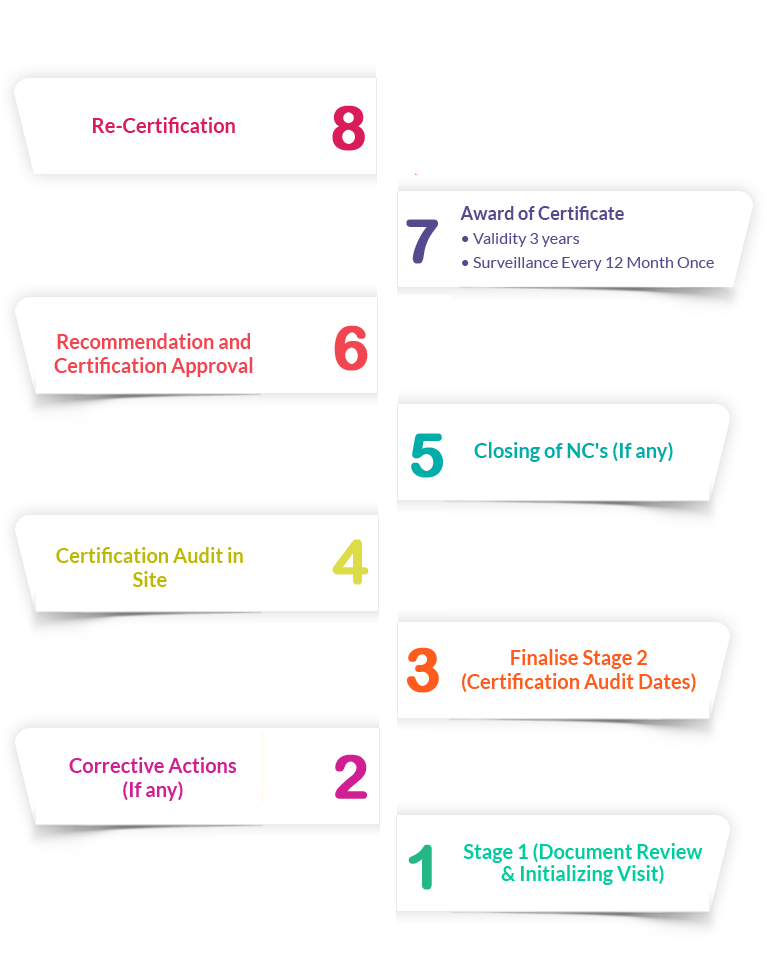
Certification Process
-
01
Preliminary Audit (Optional)
An initial review can identify gaps and help prepare your Environmental Management System for certification.
-
02
Certification Audit
Stage 1 and Stage 2 audits assess readiness, documentation, environmental controls, and practical implementation against applicable requirements.
-
03
Certification Decision
Following satisfactory audit outcomes and the required certification decision, a certificate may be issued for the approved scope.
-
04
Surveillance Audits
Periodic surveillance confirms that the Environmental Management System continues to meet applicable requirements.
-
05
Recertification
Recertification is completed before expiry in accordance with the applicable certification scheme.